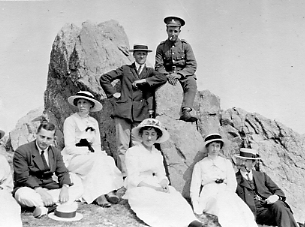
Leave in Guernsey (August 1917)
|
"The date was now August 1917 and I
was sent on leave to Guernsey taking the train
from Achiet-le-Grand. Eighteen months had
elapsed since I had left home and I had ten
days leave. I met up with John and Clarence
who were also on leave."
(it was the last time he saw Clarence
Tostevin who was killed next to his gun at
Rheims on 27 May 1918)
|
|
The Third Battle of Ypres (Sept - Nov 1917)
The 7th Division suffered significant losses
during the Third Battle of Ypres, in the fighting
for Polygon Wood, the successful advance on 4th
October east of the wood, and in the unsuccesful
assault south of the Menin Road on 26th October.
"Whilst I was in Guernsey my battery had come
out of action and had marched to Belgium where I
joined them at Hazelbrouck, Field Marshal Haig's
headquarters. The 7th Division then went to be massacred
on the worst front I have experienced, Passchendale.
The first fortnight we made advanced gun-pits in
front of Mount Kemmel and I have never seen so many
guns together. Our position was in front of Hooge
Wood, firing over Glencourse Wood ...... We were
immediately in front of Ypres with a big lake behind
us. The whole battle area was a mass of mud and
foul ground. The only shelter was a few German made
concrete pill boxes. Any number of our tanks were
stuck in the mud. We were seven weeks in this position
before we came out of action. We had then advanced
to Glencourse Wood. Battalion after battalion of
infantry were wiped out either by shell, gas or
a slow death stuck in the foul ground. Thousands
of men, horses and mules were killed. Wagons, ambulances
etc. were abandoned, stuck in the mud. The roads
had been destroyed and the British had made wooden
roads. Our own battery casualties were just over
one hundred men out of one hundred and eighty and
we retired with only two guns left out of six. We
came out of action shivering from our awful experience,
leaving our battery chums dead for someone else
to bury. We had not undressed, hardly slept and
were practically starving. It was now October 1917
and the 7th Division was inspected by General Plummer.
According to news from home the RGLI were six miles
from us, having just arrived from England."
The Piave River, Italy (Dec 1917 - Feb 1918)
Immediately on their relief, the 7th Division
was moved to Italy, being one of the British Divisions
selected to come to the support of the Italian army.
The 7th remained in Italy until the Armistice, playing
a particularly important role in the assault to
cross the Piave River.
In November 1917 Edmund wrote home that there
were rumours they were being sent to "the
place where Jack had his misfortune". Jack
was Edmund's eldest brother and his ship had been
torpedoed off the coast of Italy.
"Five Divisions were ordered to the Italian
Front to stop the Austrian push to Venice. The Divisions
were the 5th, 42nd, 43rd, 48th and mine, the 7th.
We soon entrained with all the guns, wagons, horses,
etc. for we had been made up to strength after that
awful 3rd Battle of Ypres. We went through the world's
longest tunnel, the Simplon. We were cheered at
all stations in France and, on the other side of
the Alps, by Italians and British residents. We
lost no time because the Austrians were advancing.
Disentraining after the eight day journey we started
on a ten day march which I shall never forget, walking
from 7am to 6pm every day. Luckily for us the Italians
held back the Austrians along the river Piave. The
43rd Division went straight into action but my own
division remained six weeks behind Mount Grappa
where long ranges of mountains lay in front of us.
We spent Christmas 1917 amongst the French and Italian
soldiers and despite the intense cold and hardships
we had a good time. We were on guard twice a week
and with long nights freezing hard it was awful
being alone. However we soon went into action in
the mountains, relieving 43rd Division and taking
over their guns. Things were now quiet because the
enemy had been stopped by the River Piave which
runs through Venice. We were only firing an average
of fifty rounds per gun a day. Our aeroplanes did
much good work and it was a sight to see twelve
to fourteen of them sweeping the banks of the river,
firing on the enemy infantry. The bridges across
the river were blown up and we had more or less
a good time in this position.
We were billeted in a house and it was as if we
were on manoeuvres rather than at war. One fine
day at 6pm an enemy 5.9 inch shell struck the house
and twenty of us were buried in the debris when
a second shell exploded four yards away. Our casualties
were five killed and fifteen, including myself,
wounded. We were dispatched to the Casualty Clearing
Station at the bottom of the mountain arriving there
after two hours walk and I did not get operated
on before 7am, lying helpless on a stretcher all
night . We were sent on to Genoa where we waited
for a fortnight in a big German hotel overlooking
the harbour. Then we went on a two day journey to
Marseille via Nice in an ambulance train. Mr. J.Q.
Le Pelley came to see me at Genoa but unfortunately
I had left. We were another fifteen days in Marseille
before a two day journey to Le Havre, fourteen days
there then five days outside the harbour on the
hospital ship "Grantully Castle" waiting
for the convoy and six escorting destroyers to Southampton."

Page 2 |
Page 4 
|
|