|
After the introduction of conscription in Britain
in March 1916, the government encouraged women to
take the place of male employees who had been released
from their normal occupations to serve at the front.
The appeal was successful, and by July 1914, 212,000
women were working in engineering and munitions,
but by 1918, the total was nearly a million. Many
of these women were married or were mothers whose
husbands or older sons had gone to the Front.
Shifts for "munitionettes", as they were
called, were long and conditions harsh and potentially
dangerous. They were also known as 'canaries' because
of the yellow tinge that their skin acquired by
exposure to sulphur. They produced 80% of the weapons
and shells used by the British Army and risked their
lives on a regular basis, working with poisonous
substances without adequate protective clothing
or safety measures. There were several major explosions
in munitions factories, such as the one at Barnbow
on the night of 5 December 1916, when 35 women lost
their lives.In addition, around 400 women died from
overexposure to TNT whilst handling shells during
the war.
However the rate of pay, the increased independence
and the feeling that this was a way for women to
make a positive contribution to the war effort made
work in the munitions factories an attractive proposition
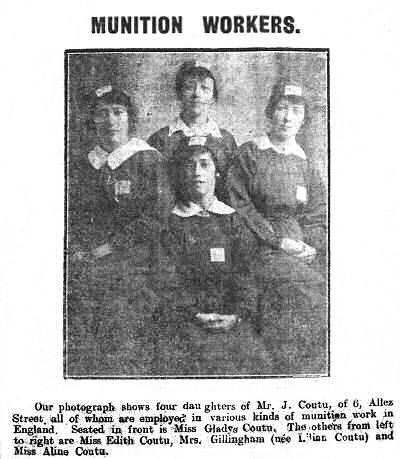
for many, including these four sisters.
|
|