Midshipman
Philip Malet de Carteret
Page 4
|
The Battle of the Falkland Islands
8th December, was to prove an exception to the rule in the
Falklands where it usually rains for 21 days during the last
month of the year, for it was a perfect mid-summers day as the
fleet was coaling in harbour.
At 7.56 am the Glasgow fired a gun to attract the
attention of Invincible who was busy coaling, that Canopus had
reported smoke in sight to the south. At 8.15 am a signal came
from the flagship to "Raise steam for full speed, report
when ready"
The enemy's two leading ships Gneisenau and Nurnberg
were in sight approaching the Wireless Station. When they were
near Wolf Rocks they stopped engines and turned north-eastwards.
Canopus opened fire over the low neck of land at 9.20 am with
her 12 inch guns, firing five rounds at a range of 12,000 yards.
Hoisting their colours, the enemy turned away to the south east
to join the main squadron.
From survivors it appears that one of Canopus's
shells had ricocheted, striking the Gneisenau at the base of her
after funnel. It was also claimed that a piece of another hit
the Nurnberg.
At 9.45 am the British squadron weighed and proceed
from harbour, the last of whom cleared by 10.30 am. Glasgow came
out first, followed by the two battle-cruisers doing 25 knots,
followed by Kent, Carnarvon and Cornwall doing about 22 knots.
The Admiral reduced speed for an hour to 20 knots at 11.15 am
to allow the "County" cruisers to catch up. At 12.47
pm he hoisted the signal "Open Fire" and eight minutes
later the Inflexible fired the first round of the battle at the
Leipzig. The Invincible followed almost immediately after. Both
ships were going their full speed, nearly 27 knots and firing
at a range of 16,000 yards (over 9 land miles).
|
|
The fight between the two British battle-cruisers and the
German cruisers lasted between 3 and 6 hours. The Scharnhorst
sank at 4.17 pm and the Gneisenau heeled over at about 5.45
pm. Invincible had been hit about 22 times, 18 directly
and had a list to port as two shells had struck below the
waterline. The Wardroom had been demolished. There had been
no casualties amongst her crew of 950 men. The Inflexible
had 2 hits, 1 crew killed and 3 wounded.
The British squadron in total lost 7 men killed and 18
wounded (3 subsequently succumbed). The Germans lost 2,260
men. The Dresden was the only ship to escape and was later
sunk on 14th March, 1915 by the Kent and Glasgow.
Vice-Admiral Sturdee was rewarded with a baronetcy.
|
|
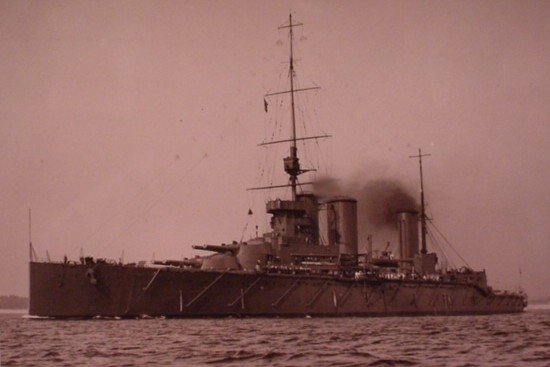
HMS Inflexible
|
Page 3 |
Page 5 
|